
Residential vs Commercial Solar Guide

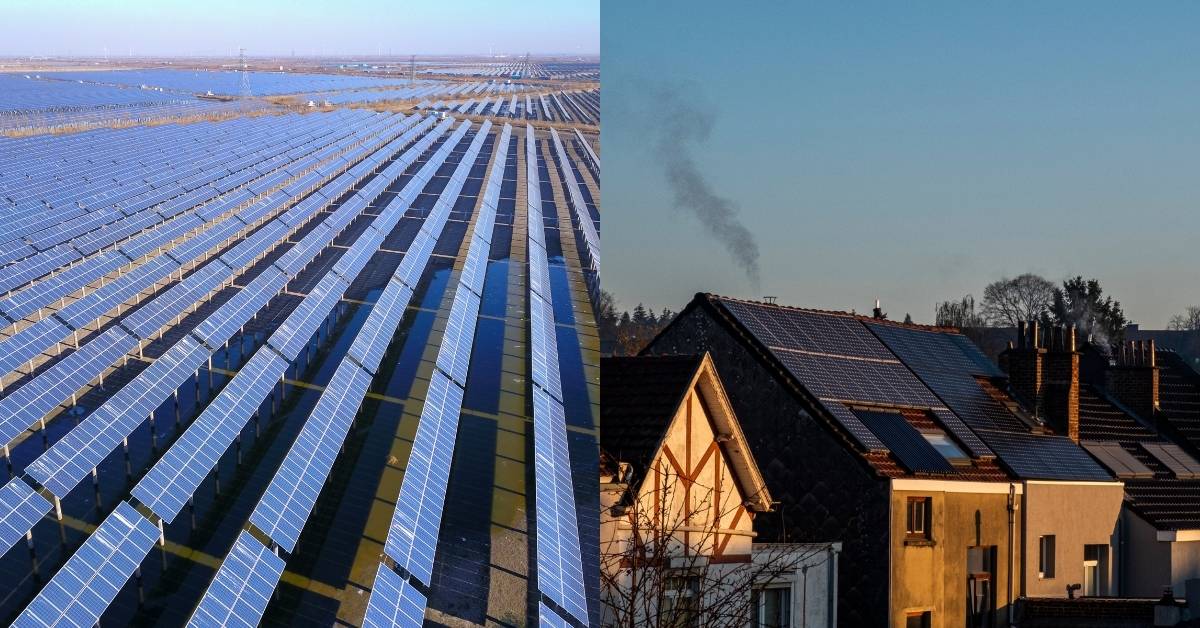
Which Is Right for Your Property or Business?
Solar power has moved from “nice to have” to essential infrastructure across South Africa. Rising electricity tariffs, ongoing load-shedding, and the need for predictable energy costs have pushed both homeowners and businesses to consider independent power solutions.
But not all solar systems are designed the same.
A home installation and a business installation serve very different energy demands, budgets, and return expectations. Choosing the wrong type can mean overspending, underpowering your operations, or limiting future growth.
This guide explains the differences clearly so you can decide which solar solution fits your property, usage patterns, and long-term goals.
The best solar system isn’t simply the biggest or most advanced. It’s the one that matches how and when you use electricity, fits your budget, and supports your long-term plans without unnecessary complexity. A properly sized system will always outperform an oversized or undersized one.
Residential vs Commercial Solar: What’s the Difference?
Quick summary
- Residential solar powers homes using smaller systems designed for daily household loads
- Commercial solar supports businesses with larger systems built for high, continuous energy demand
- The key difference is scale, usage profile, and ROI structure
- Residential systems prioritise bill reduction and backup power
- Commercial systems focus on cost control, uptime, and long-term operational savings
- Homes typically use 3–10 kW systems, while businesses often require 20 kW to several hundred kW
In simple terms, homes aim for stability and savings, while businesses aim for efficiency and resilience.
Understanding Your Energy Needs Before Choosing Solar
Before comparing system sizes, costs, or payback periods, there’s one step that matters more than anything else: understanding how you actually use electricity.
Many people start their solar journey by asking, “How big a system should I buy?” But the better question is, “How much power do I really use, and when do I use it?”
Solar performance isn’t just about capacity. It’s about alignment. A system that matches your daily consumption pattern will always outperform one that simply looks impressive on paper.
What Is Residential Solar?
Residential solar systems are designed to power everyday household consumption. These installations are typically mounted on rooftops and sized to support lighting, appliances, electronics, and essential systems such as refrigerators and security equipment.
Most home systems in South Africa fall between 3 kW and 10 kW, depending on:
- Property size
- Number of occupants
- Lifestyle and appliance usage
- Backup power requirements during outages
A typical setup includes solar panels, an inverter, and battery storage for hybrid or backup capability.
Homeowners often install solar to:
- Reduce monthly electricity bills
- Protect against load-shedding
- Increase property value
- Gain partial or full energy independence
If you’re exploring options for your home, APS offers tailored solar systems for homes that are sized around actual consumption rather than estimates.
https://affordablepowersolutions.co.za/solar-systems-for-homes/
What Is Commercial Solar?
Commercial solar systems serve businesses, warehouses, offices, retail spaces, and light industrial facilities. These environments use significantly more energy throughout the day and often require uninterrupted power to operate effectively.
Systems are therefore larger and more complex, typically starting at 20 kW and scaling into hundreds of kilowatts.
Unlike residential systems, commercial solar focuses on:
- Reducing operational costs
- Stabilising energy expenses
- Maintaining uptime
- Improving business continuity
- Supporting sustainability goals
Many businesses use their rooftops, carports, or ground space to generate power at scale.
Commercial installations are less about short-term savings and more about long-term return on investment.
APS designs commercial solar solutions for business environments where reliability and financial performance are critical.
https://affordablepowersolutions.co.za/commercial-solar-for-business/
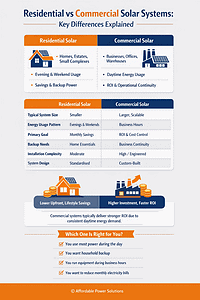
Key Differences Between Residential and Commercial Solar
Although both use the same core technology, the design logic differs substantially.
|
Factor |
Residential Solar |
Commercial Solar |
|
System size |
3–10 kW typical |
20 kW – 500+ kW |
|
Primary goal |
Bill savings + backup |
Cost control + uptime |
|
Usage pattern |
Morning/evening peaks |
Daytime continuous loads |
|
Installation |
Simple rooftop |
Multi-roof/ground/carport |
|
Budget range |
Lower |
Higher capital investment |
|
ROI |
Lifestyle + savings |
Financial return-driven |
|
Scalability |
Limited |
Designed for expansion |
Residential systems are often standardised. Commercial systems are engineered.
Cost, Savings, and ROI
This is usually where most decisions are made.
While both options reduce grid dependence, the financial logic behind each is different.
Upfront cost differences
Commercial systems require:
- More panels
- Larger inverters
- Structural assessments
- Professional electrical integration
This results in higher initial investment compared to residential installations.
Residential systems, by comparison, are smaller and faster to deploy.
kW output differences
A useful rule of thumb:
- Homes → single-digit kW output
- Businesses → tens or hundreds of kW
Higher output directly impacts savings potential.
Payback periods
Residential payback often depends on:
- Household consumption
- Tariff increases
- Battery usage
Typical ranges: 4–7 years
Commercial payback is usually faster because:
- Businesses consume more power during solar production hours
- Savings accumulate daily
- Systems offset expensive peak tariffs
Typical ranges: 3–5 years, sometimes shorter for high-usage facilities.
Why commercial ROI behaves differently
Businesses operate during daylight hours, exactly when solar produces the most energy.
This natural alignment increases efficiency and improves returns.
Homes, on the other hand, consume more power at night, which means batteries play a bigger role.
In short:
- Residential → savings + protection
- Commercial → measurable financial performance
Installation Differences
The installation approach also varies significantly.
Residential installations
Most homes can be completed within:
- 1–3 days
- Minimal structural adjustments
- Straightforward electrical integration
Panels are mounted on pitched or flat roofs, with a compact inverter and battery setup inside the property.
Commercial installations
Commercial projects involve:
- Engineering assessments
- Load studies
- Larger wiring infrastructure
- Compliance checks
- Multi-phase power integration
Timelines may range from several days to multiple weeks, depending on size.
These systems are also designed for scalability, allowing additional capacity later.
Off-grid vs hybrid
Both residential and commercial systems can be:
- Grid-tied – lower cost, no batteries
- Hybrid – batteries + grid support
- Off-grid – fully independent
Hybrid systems are increasingly popular in South Africa because they provide backup during load-shedding without requiring full independence.
Residential vs Commercial vs Agriculture
Agricultural operations often sit between the two models.
Farms and rural properties may require more energy than a home but less than a factory. Loads such as:
- Irrigation pumps
- Cold storage
- Workshops
- Equipment sheds
Create a steady daytime consumption similar to commercial use.
As a result, agricultural systems are typically custom-designed hybrids, combining residential simplicity with commercial scalability.
The best solar system isn’t simply the biggest or most advanced. It’s the one that matches how and when you use electricity, fits your budget, and supports your long-term plans without unnecessary complexity. A properly sized system will always outperform an oversized or undersized one.
We’ll explore this category in more detail in a future guide.
When to Choose Each Option
Choose residential solar if:
- You’re powering a household
- Your goal is bill reduction and backup power
- You want a straightforward rooftop solution
- Energy demand is moderate and predictable
Choose commercial solar if:
- You run a business or facility
- Electricity costs impact profitability
- Downtime affects operations
- You require a larger capacity or scalability
Consider a hybrid/agricultural approach if:
- You operate pumps, machinery, or storage facilities
- Usage sits between home and industrial levels
- You need reliability in remote areas
If you’re unsure which category applies, a professional assessment can help determine system sizing and design.
Your Next Step Toward Smarter Energy Independence
Residential and commercial solar systems share the same technology, but they solve different problems.
Homes benefit from stability and savings.
Businesses benefit from cost control and operational resilience.
The right choice depends less on labels and more on how you use energy.
If you’d like guidance on system sizing or options, APS provides assessments for both home solar installations and commercial solar power solutions, along with practical advice on financing and implementation.
Learn more or request an evaluation here:
https://affordablepowersolutions.co.za/contact/